The king’s attempt to revive the dead witch-hunting hound
The Tales of Beedle the BardThe King’s attempt to revive the dead witch-hunting hound Sabre is the decisive test in “Babbitty Rabbitty and Her Cackling Stump”: it reveals that the King’s apparent command of magic is a sham and that no magic can bring the dead back to life. When his attempt fails, the charlatan redirects suspicion toward Babbitty, setting off her flight and helping expose the danger of a ruler who persecutes magic he does not understand.
Context and Stakes
The episode follows a public demonstration in which the King, encouraged by a charlatan and secretly assisted by Babbitty, appears to perform magic. Hidden inside a bush, Babbitty has made the horse rise into the air while the crowd credits the King. The display leaves him searching for another feat to perform, and the Captain of the Brigade of Witch-Hunters supplies one: revive Sabre, the largest of the witch-hunting hounds, who has died after eating a poisonous toadstool.
The request turns the spectacle into a test with a boundary no wand can cross. The King believes that learning incantations and waving a wand can make him a wizard, but his performance depends on Babbitty’s concealed intervention. The dead hound makes it impossible for that arrangement to continue: its stillness will show the crowd what the King cannot do, whatever the earlier feats appeared to prove.
The Failed Attempt
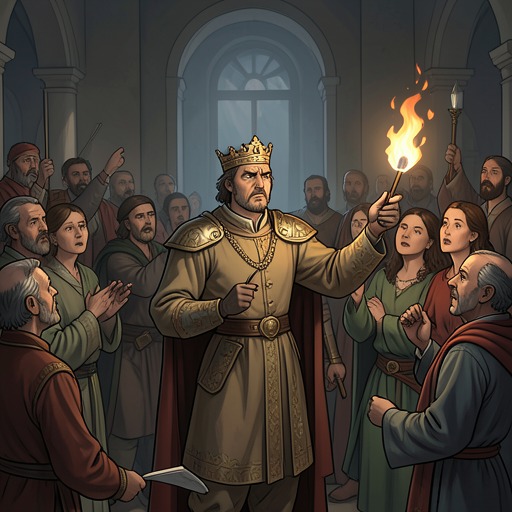
The Captain brings Sabre’s lifeless body onto the stage and tells the King to bring him back with the wand. The foolish King brandishes his twig and points it at the dog. Inside the bush, Babbitty smiles but does not raise her own wand. The narration makes the reason explicit: no magic can raise the dead. Unlike the levitating horse, the attempted revival is not a feat that a hidden witch can secretly perform on the King’s behalf.
When Sabre does not stir, the crowd first whispers and then laughs. The failed act changes how the audience reads what came before: they begin to suspect that the King’s first two feats were tricks. The public’s amazement gives way to doubt, and the King’s dependence on appearances becomes visible precisely when the performance demands a real return to life.
Exposure and Escape
The King screams at the charlatan, demanding to know why the magic has failed. The charlatan responds with the only ruse left to him: he points toward the bush and claims that a wicked witch is blocking the King’s magic. He urges the crowd to seize Babbitty, shifting blame from the King’s failed attempt to the woman whose hidden work had made his earlier demonstrations appear successful.
Babbitty flees as the Brigade of Witch-Hunters pursue her and release their hounds. At a low hedge, she vanishes from sight. When the King, charlatan, and courtiers follow, they find the hounds gathered around a bent, aged tree. Her escape turns the accusers’ own pursuit into evidence of their confusion: they have blamed her for the King’s failure, but cannot identify what she has become.
Significance
The failed revival gives the episode its sharpest reversal. The King seeks to use a display of power to strengthen his authority, but the death of one of his own witch-hunting hounds reveals the difference between a staged appearance and what magic can actually accomplish. The story’s rule is categorical: the dead cannot be raised. Later commentary places this limit within a broader account of wizarding knowledge, noting that magical society has devised ways to maintain the illusion of loved ones’ continued presence without reuniting body and soul after death.
The scene also binds the King’s credulity to his persecution of witches. He is eager to claim magical power, yet unable to recognize its nature; when the test exposes that ignorance, his charlatan turns his fear toward the concealed witch. In the wider fable, Babbitty’s escape and the exposure of the fraud contribute to the end of persecution in the kingdom. The attempted resurrection therefore does more than fail: it breaks the performance on which the King’s claim depends and makes the limits of his power public.